Hallstatt Christmas Market: A Lakeside Advent Day
Hallstatt's Christkindlmarkt fills the old market square of an Alpine lake village, and the regional tourism board lists it as a single day. Here is what to eat, see and plan.
- Best known for
- A UNESCO World Heritage village on a lake
- Market
- Christkindlmarkt on the historic Marktplatz
- Market format
- Listed as one day, 8 December; confirm each year
- Signature treats
- Holzknechtnocken, Maroni, Bratwürstl, Glühwein
- Local greeting
- Frohe Weihnachten (Merry Christmas, in German)
Hallstatt's Christmas market is not a month-long affair. The regional tourism board's list of Christkindlmärkte gives it a single day, 8 December, and headlines it as a one-day-only event. That date is the feast of the Immaculate Conception, a public holiday in Austria, and the parish marks the morning with a High Mass. Hallstatt has fewer than 800 residents, one lake and one steep mountainside, so a market that lasts a day is less a lack of ambition than a question of floor space.
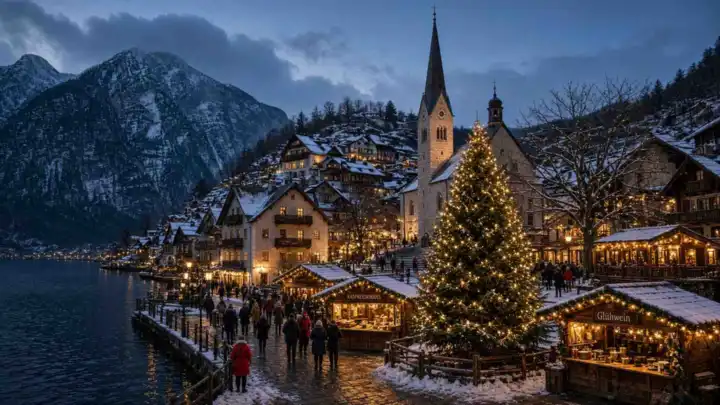
The Christkindlmarkt on the Marktplatz
The market sets up on the old market square, under a big Christmas tree and beside a life-size wooden nativity scene. Brass players known as Turmbläser provide the music. The stalls sell handmade crafts and tree decorations made by people from the village and the surrounding area, and the tourism board pitches the gifts as the opposite of kitsch. Home-distilled schnapps and brandies are on the shopping list too.
What sets it apart is who runs it. Local clubs do the cooking and baking, from the costume society to the water rescue, the alpine club and the mountain rescue, and their preparations start in early autumn. Most of us picture a rescue service with a stretcher. Here you may also meet one holding a ladle.
What to Eat and Drink at the Market
The list is short: Glühwein, roasted chestnuts (Maroni) and Bratwürstl. Then there is the dish to hunt for, Holzknechtnocken, which the tourism board calls the traditional food of the Holzknechte, the woodcutters. A dumpling meant to fuel someone who has spent the day felling trees will not leave you hungry. For the rest of the Alpine menu, see our guide to what to eat at an Austrian Christmas market.
Krampus, St Nicholas and Other Advent Customs
Early December in Hallstatt is not all candles. The board has listed a children's Krampus run and a later evening run on the village square, with St Nicholas, a fire show and hot drinks. The Krampus is the horned companion of Nicholas in Alpine custom, there to frighten the naughty. The board assures visitors the local ones are not so bad after all, which is good to hear before a masked figure runs past your elbow. Our guide to Christmas markets with Krampus traditions lists more places to meet him.
The season closes with the Glöckler runs on 5 January, the eve of Epiphany. Groups in white wearing illuminated headgear move through the dark, notably in Bad Goisern and Obertraun on the same lake, and the custom is on Austria's list of intangible cultural heritage.
Planning a Christmas Visit to Hallstatt
The village sits inside a UNESCO World Heritage cultural landscape, and Wikipedia calls it a prime example of overtourism in Austria: thousands of day visitors on busy days, mostly off tour buses, and time slots for coaches as the response. The quiet way to see it is to stay the night.
- Check the date and format on the tourism board's pages before you book anything. A one-day market can change from season to season.
- Stay overnight if you can. Day coaches arrive in slots, and a night in the village lets you see the square after the day-trip crowd has moved on.
- Dress for a mountain lake in December: layers, waterproof boots, a hat. The market is outdoors.
- Book rooms early. A village of this size has only so many beds.
Beyond the stalls, Hallstatt has a viewing platform above the village, a chapel ossuary holding more than 1,200 skulls (about 600 of them painted) and what Wikipedia calls the world's oldest working salt mine. Check winter opening hours for each.
If one day is too short, the Salzkammergut has more: the same tourism board lists Christkindlmärkte from Bad Ischl through Gosau and Bad Goisern to Bad Aussee. For a bigger market, our Salzburg page covers the Christkindlmarkt by the cathedral, and our guide to Christmas markets in small villages covers places of this size. The country picture is on our Austria page, and our story Christmas Market in the Village is a lighter read on the same theme.
Official information
Frequently asked questions
When is the Hallstatt Christmas market?
The regional tourism board's market list gives 8 December, the feast of the Immaculate Conception, and headlines it as a one-day-only event on the historic Marktplatz. Format and hours can change from season to season, so confirm on the tourism board's site before booking travel or a room.
What is there to do in Hallstatt besides the Christmas market?
Wikipedia lists a viewing platform above the village, the ossuary with more than 1,200 skulls, a local museum and the salt mine, described as the world's oldest working salt mine. Opening hours change in winter, so check each attraction before you go.
Are there Krampus runs in Hallstatt?
Yes. The regional tourism board has listed a children's Krampus run and an evening run, with St Nicholas and a fire show, on the village square in early December. Dates change every year, so check the board's Krampus page before you plan around them.